
The 30-share Sensex ended down 604 points at 28,845 and the 50-share Nifty ended down 181 points at 8,757. The Bank Nifty ended down 602 points at 19,146.

Foreign Portfolio Investors purchased stocks worth about Rs 56,123 crore in 2016-17

India must carry on structural reforms, the finance minister said.

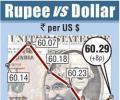
After a a steep fall last week, the rupee has closed slightly stronger against the dollar.

Oil tanked to a 7-year low as OPEC decided to maintain production.

The dollar maintained its bullish momentum in Asian and early European trade

Sensex,Nifty to remain under pressure through the week.

All the sectoral indices, led by realty, metal, consumer durables and power were trading in the negative zone on Thursday.

Many giving double-digit returns, with India up less than one per cent; even so, it has done much better than other emerging markets.

Foreign investors have pulled over Rs 6,400 crore from the Indian equity market in the first four trading sessions of the ongoing month when the Reserve Bank of India (RBI) and US Federal Reserve raised interest rates. Given the headwinds in terms of elevated crude prices, inflation, tight monetary policy among others, FPIs' flows in India are expected to remain volatile in the near term, Shrikant Chouhan, Head - Equity Research (Retail), Kotak Securities, said. Foreign Portfolio Investors (FPIs) remained net sellers for seven months to April 2022, withdrawing a massive amount of over Rs 1.65 lakh crore from equities. This was largely on the back of anticipation of a rate hike by the US Federal Reserve and due to the deteriorating geopolitical environment following Russia's invasion of Ukraine.

Forex dealers said besides continued demand for the American currency from importers, increased capital outflows by foreign funds kept pressure on the rupee.
Foreign funds sold Indian shares worth 446.9 million rupees ($7.4 million) on Wednesday, provisional exchange data showed, marking the third consecutive session of outflows.

Out of the 30-share Sensex pack, 21 ended lower and one remained unchanged

Markets ended in green on rate cut hope.

Dalal Street investors became richer by more than Rs 16.36 lakh crore this year as the equity market scaled new highs despite persistent geopolitical uncertainties and inflation worries. Analysts attributed better macroeconomic fundamentals, the confidence of retail investors and foreign investors investing again in the domestic equities towards the latter half of 2022 as the key factors that led to the outperformance of the Indian market in comparison to many other stock markets worldwide. During the initial part of the year, markets were jolted by the Russia-Ukraine war.

Rupee movement, global cues key for stocks this week: Experts

However, it is noteworthy that foreign investors pumped in money on the day of election results as the mandate became clear

On the macro front, market participants will closely watch the FY'15 fiscal deficit target

The broader NSE Nifty too fell below the 10,100 level by dropping 100.10 points to end at 10,094.25

Experts say foreign investor sentiment was bolstered by the US Federal Reserve's decision to go slow with interest rate hikes and hopes of political stability.

The rupee on Thursday recovered by a hefty 60 paise to 53.24 against the US dollar in early trade on the Interbank Foreign Exchange market after the Reserve Bank tightened norms for utilisation of the foreign currency fixed deposit funds to check outflow of forex.

The clarification by the National Securities Depository (NSDL) - which is tasked with monitoring foreign portfolio investor (FPI) investment in domestic stocks - that the accounts of top investors in Adani group stocks remain 'active' has helped prevent a $500-million selloff of shares. Analysts said a freeze of the FPI accounts, as reported by some media outlets, could have prompted global index providers to cut weighting of four Adani group companies from their global indices. Brian Freitas, an analyst at independent research provider Smartkarma, said if the FPI accounts were indeed frozen, FTSE and MSCI would have reduced weighting of Adani group companies at the next rebalance, since it would have meant that the large part of the free float was not tradeable.

The NSE Nifty after shuttling between 10,441.90 and 10,341.90, ended 6.15 points, or 0.06 per cent down at 10,380.45.

Sentiment took a dramatic change particularly in the last one hour of trading with the lower opening of the European markets and investors booking profits in broader markets at record levels

This could be attributed to the attractive valuation of the Indian equities after the sharp correction during the first quarter of calendar year 2020 and significant depreciation of the Indian rupee against USD, which provided them a rather good entry point.

As markets complete the first half of the calendar year 2022 (CY22) with a fall of around 9 per cent, the interest-rate hike trajectory by global central banks, paired with the conundrum of inflation and growth, will move the needle for the market, observe experts. Here's a quick rundown on what they'll react to over the next six months.

'Given the worries about sluggish growth, rising interest rates and likely volatility, it's quite logical to infer that the SIP route could be the preferred way of investing.'

Although the RBI's open market operations have ensured sufficient system-level liquidity, some sectors are finding liquidity to be a challenge owing to their credit profile.

Sebi has put in place a strong deterrence to check any misuse of participatory notes.

Tata Steel was the top loser in the Sensex pack, sinking over 5 per cent, followed by SBI, IndusInd Bank, Bajaj Finance, HDFC Bank and NTPC. NSE Nifty tanked 371 points to 16,614.20.

The top losers from the Sensex pack are ONGC, Coal India, Vedanta, Reliance Inds and L&T.
Continued outflows amid moderation of domestic investments are a concern

Pakistan's current account deficit (CAD) increased to a 4-year high of $17.4 billion in the fiscal year of 2021-22, indicating more troubles for the ailing economy of the cash-strapped country. The State Bank of Pakistan (SBP) on Wednesday reported that the country recorded a CAD of $17.406 billion in FY22 compared to a gap of just $2.82 billion in FY21. According to Dawn newspaper, the massive CAD speaks a lot about the severe problem of the balance of payments.

The rupee has depreciated by about 25 per cent in the past three months, from close to Rs 83 in mid-May, while it was even higher at about Rs 80 against the British Pound in March.

The NSE Nifty cracked below the 10,800-mark to hit a low of 10,753.05 intra-day, before closing at 10,762.45 with a loss of 59.40 points, or 0.55 per cent.

Investors remained cautious in the face of the expiry of November series contracts in the derivatives segment, which also dampened sentiment.

'A soft landing of the Indian economy would be a long-term positive for the equity markets.'

Worried over excessive outflow of foreign exchange as royalty and fees for technology transfer and use of brand names, Commerce and Industry Minister Anand Sharma wrote to Finance Minister P Chidambram on the matter.
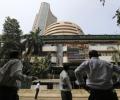
Other losers included HCL Tech, Yes Bank, IndusInd Bank, TCS, ONGC, Bajaj Finance, PowerGrid, Vedanta, Asian Paints, NTPC and Hero MotoCorp, which shed up to 4.07 per cent.

The broader Nifty of National Stock Exchange scaled the 10,200 mark intra day before closing at 10,184.85, showing a sizeable gain of 38.30 points, or 0.38 per cent.
